Cardioid Subwoofer Setup for Bars: A Practical Guide
How to arrange, delay and power a cardioid subwoofer array in a bar so bass stays on the dance floor and off the neighbours, staff and stage.
Cardioid subwoofer setup is one of the few free upgrades in live sound. You are not buying more output; you are redirecting what you already own. In a bar, that matters more than in a warehouse-sized club, because the room is small, the ceiling is low, the bar staff are close to the stack, and there is often a residential wall or a neighbour above. A cardioid arrangement can put 10 to 20 dB of rejection behind the subs when it is done properly, and almost nothing when it is done carelessly.
What cardioid actually means in a bar
A cardioid sub array produces strong output in front and a deep null behind. It does this by combining two or more subwoofers with a delay and, usually, a polarity inversion on the rear-facing cabinet. The physics is the same as a cardioid microphone, just at 40 to 100 Hz instead of speech. The result is directional bass: more energy where the audience is, less where the bar, the stage, the entrance or the neighbour's bedroom is.
Directional subwoofers are not a substitute for good acoustic treatment or sensible level control. They simply change where the low end goes. In a narrow bar, that can be the difference between a usable dance floor and complaints.
The three arrangements that work
There are three practical layouts. Each has trade-offs.
- Two-box forward-rear: one cabinet facing the audience, one directly behind it facing away, rear box delayed and polarity inverted. Simple, compact, and the most common choice for bars. You lose roughly half your forward output compared with two boxes facing forward, but you gain the rear rejection.
- Three-box end-fire: three cabinets in a line, each progressively delayed so the energy adds in front and cancels behind. No polarity inversion needed. More forward output than the two-box method, but it needs a long footprint, which many bars do not have.
- Two-box side-by-side with delay: a variant used where space is tight, but the rear rejection is narrower and less predictable. Treat it as a compromise.
For most bars, the two-box forward-rear arrangement is the right starting point. It fits under a stage lip or against a wall, and it is easy to explain to a bar owner.
Placement rules that matter more than the maths
The array will only behave cardioid in front of a boundary if you respect a few physical rules.
- Keep the cabinets coupled. The rear-facing box should sit as close as possible to the front box, ideally touching or within a few centimetres. Gaps create leakage and spoil the null.
- Get the stack off the floor if you can. Half-space loading boosts output but also makes the rear radiation harder to control. A low stage or a plinth helps.
- Do not jam the array into a corner. Corners load the rear of the array and reduce rejection. Leave at least a metre of clear space behind where possible.
- Aim the null at the problem. If the bar is behind the subs, point the rear of the array at the bar. If the complaint comes from upstairs, the null will not help much; you need mechanical isolation instead.
- Keep the array away from the wall behind the stage. A wall 30 cm behind the rear-facing cabinet will reflect energy straight back into the room.
Delay and polarity settings
The delay is the whole trick. As a starting point, set the rear cabinet's delay to the physical distance between the two cabinets' acoustic centres, plus a small offset, then invert polarity on the rear box. If the boxes are 60 cm apart, start around 1.7 ms and sweep between roughly 1.4 and 2.2 ms while listening or measuring behind the array.
You need a measurement tool to do this well. A cheap measurement microphone and free analysis software will get you most of the way. Walk the room, watch the low-frequency response behind the array, and adjust the delay until the null is deepest in the 50 to 80 Hz region, which is where most bar complaints originate.
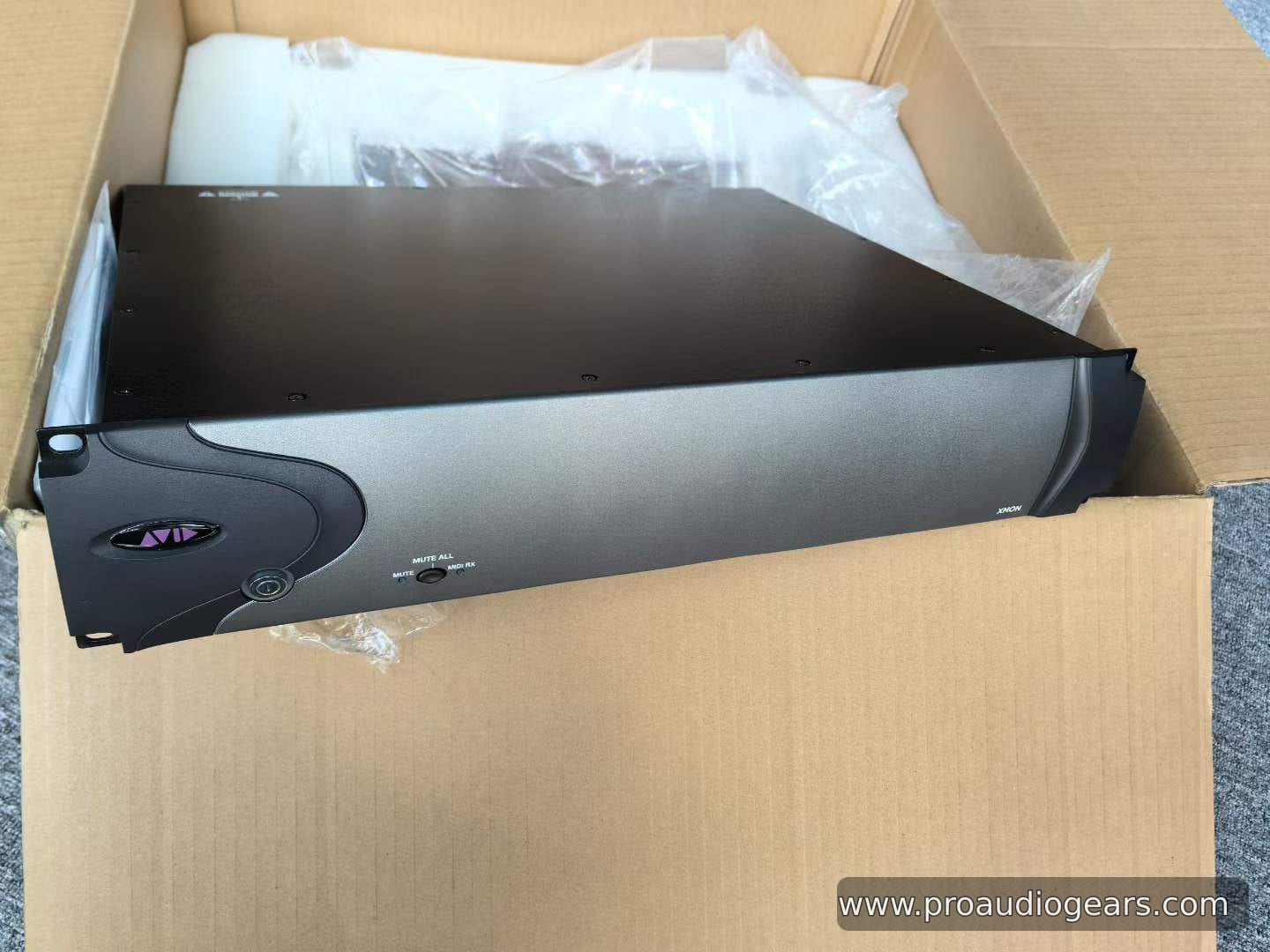
A digital processor makes this far easier than an analog crossover. If you are specifying a rack, a unit like the Peavey X-COM digital signal processor gives you the parametric EQ, delay and polarity control you need per output, and is a sensible anchor for a small bar system. Do not try to run cardioid from a passive crossover.
Choosing cabinets for a bar cardioid array
Matched cabinets are essential. Two different sub models will not sum or cancel predictably, and you will spend hours chasing a null that never appears. Buy pairs.
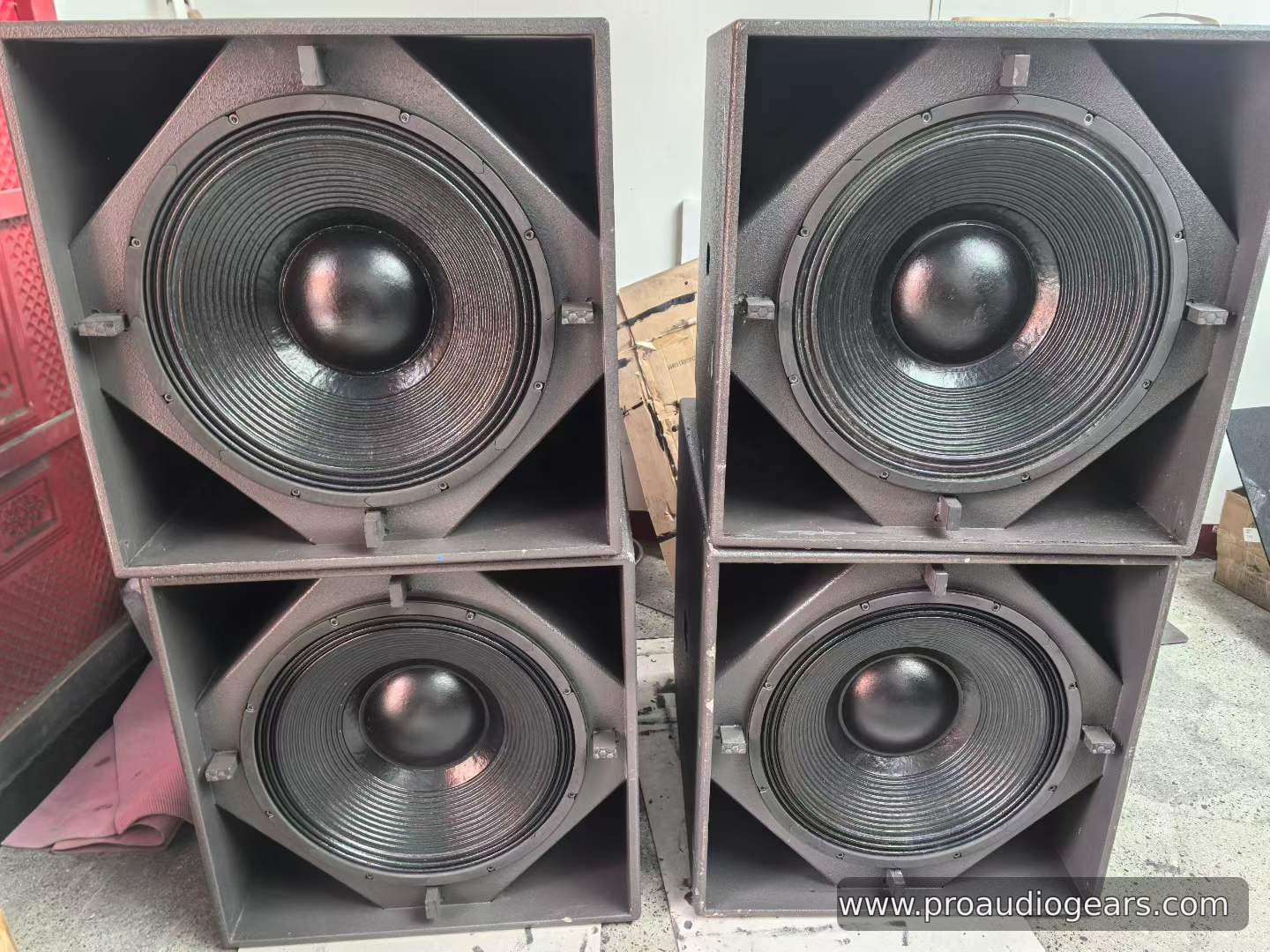
For bars, 15-inch or single 18-inch cabinets are usually the right size. Dual 18s are tempting on paper, but in a small room they tend to be too tall, too heavy for the access route, and too much output for the space. If you already own large cabinets, the cardioid arrangement still works, but check the footprint before you commit. A pair of horn-loaded subwoofers can be effective in a forward-rear array provided both cabinets are identical and you have the depth to stack them; horn subs also load differently from bass reflex boxes, so measure rather than assume.
Condition matters here. Used subs with tired surrounds, mismatched drivers or a replaced woofer will not cancel cleanly. Inspect both cabinets together, compare cone movement, and check that the drivers are the original model. A cardioid array is a matched pair in the truest sense.
Amplification and processing
Each cabinet needs its own amplifier channel and its own processing channel. Sharing an amp channel between the front and rear boxes defeats the purpose, because you cannot delay or invert one without the other.
Size the amplifier for the array, not for a single box, and leave headroom. Cardioid arrays are less efficient in front than the same number of boxes facing forward, so you will be pushing the front cabinet harder. A solid used amp with plenty of current delivery is a better buy than a marginal one running near clip. Check the amp's ability to drive low impedances if you are paralleling cabinets.
Set a high-pass filter around 35 to 40 Hz. Bars rarely reproduce anything useful below that, and removing it protects the drivers and cleans up the low end. Set the low-pass where your tops take over, usually 80 to 100 Hz.
Practical checks before you call it done
Once the array is in place, verify it in the room rather than on paper.
- Play pink noise and walk a line from the front of the stage to the back of the bar. The low end should drop noticeably as you pass behind the array.
- Check the dance floor for a hole. A badly set delay can create a null in the audience area instead of behind the array.
- Listen at the bar. Staff exposure matters, and a cardioid array is one of the few tools that genuinely reduces it.
- Check the stage. If the null lands on the drummer, they will complain, and rightly so.
- Re-check after any furniture move. Bars get rearranged, and a new banquette can undo your work.
A realistic expectation
Cardioid sub setup is not magic. It will not fix a room with a resonance problem, and it will not let you run louder than the neighbours will tolerate. What it does is put the bass where you want it, which in a bar is usually the dance floor and not the bar, the till or the flat upstairs. Plan for a matched pair, a processor with delay and polarity per output, and an hour with a measurement mic. That is the whole recipe.