Buying a Used Subwoofer for Nightclub Installation
A practical guide to choosing used subwoofers for nightclub installs: box count, amp matching, power and acoustics, condition checks, and what to verify before you buy.
Nightclub low end is a different job from concert low end. A touring rig needs maximum output for a few hours and then goes back in the truck. A club subwoofer runs six nights a week, often at high level for eight hours, in a room with hard surfaces and a low ceiling. Buying used is a sound way to get serious output per dollar, but only if you match the boxes to the room and the amplification, and inspect them properly. Here is how we approach it.
Start with the room, not the driver size
A single 18-inch sub in a small basement bar and a stack of dual 18s in a 600-capacity room are not the same purchase decision. Before you look at listings, estimate the usable volume of the dance floor, the ceiling height, and how much of the low end will be absorbed by people, soft furnishings and open doors. Crowded rooms lose bass; empty rooms flatter it. If you commission the system on an empty Thursday, it will sound thin on a Saturday.
As a rough starting point, most club installers aim for enough sub capacity that the system runs at 60 to 70 percent of its limits on a normal night, leaving headroom for peak tracks. Underpowered sub sections get driven into limiters, and clipped low end is the fastest way to destroy drivers that were perfectly good when you bought them.
Powered or passive: decide early
Powered subwoofers simplify installation. You run signal and mains, set delay and level, and you are done. For a club with limited rack space and no dedicated amp room, a self-powered box is often the pragmatic choice. A used RCF SUB 8006-AS is a common sight in mid-size rooms: an 18-inch powered design with onboard processing, easy to array in pairs or fours, and straightforward to service because the amplifier module is a single replaceable unit.
Passive boxes give you more flexibility on amplification and let you standardise on one amp platform across the whole system. If you already run a rack of Powersoft or Lab.gruppen, passive subwoofers can be the cheaper route per box and easier to integrate with existing processing. The trade-off is more cabling, more rack weight and more setup time.
Matching amplifier power to the boxes
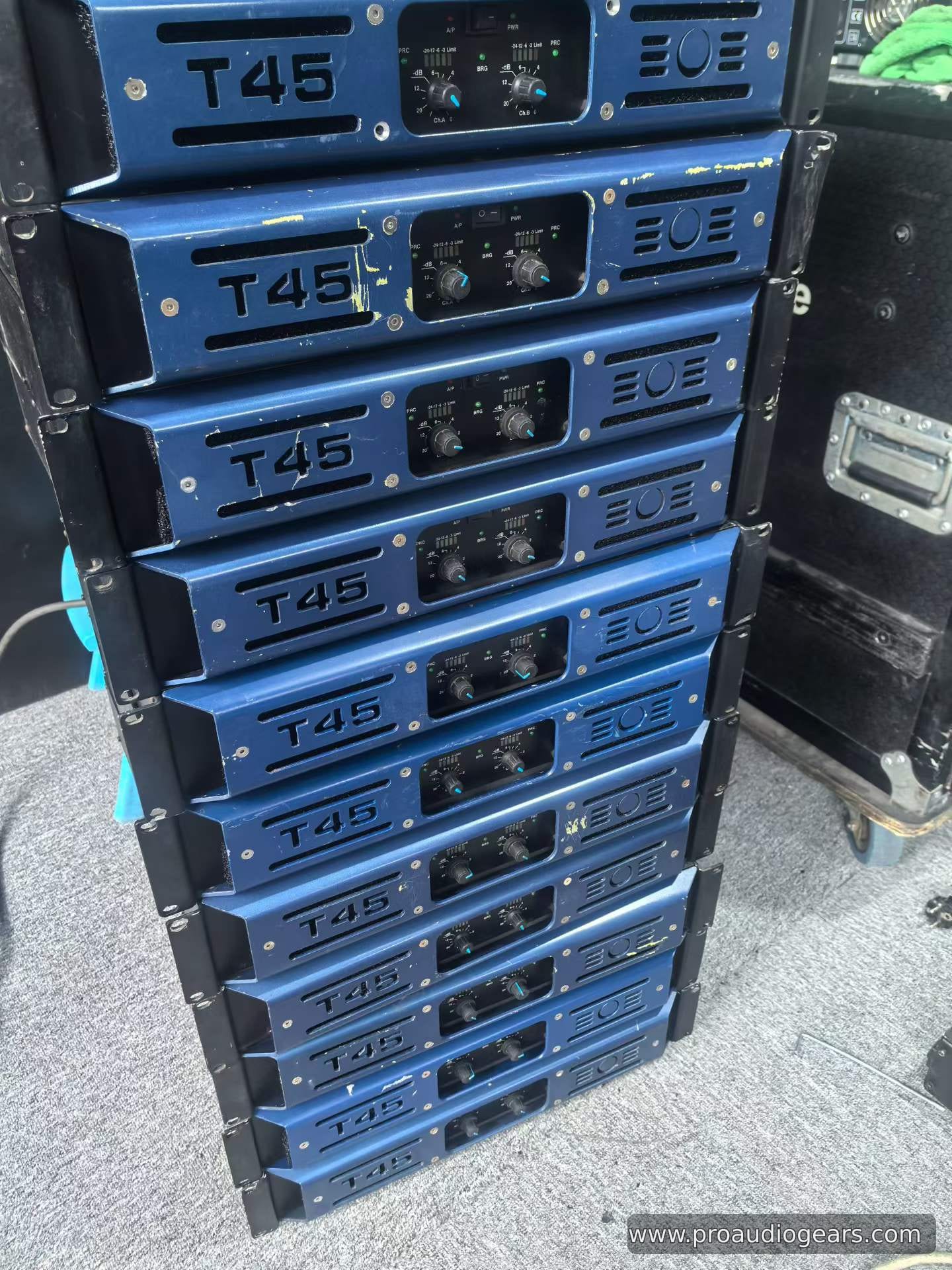
This is where most used subwoofer purchases go wrong. A dual 18-inch cabinet rated at, say, 1600 watts AES needs an amplifier that can deliver that continuously, not just on paper at 1 kHz. Look at the amplifier's rating across the subwoofer band, its ability to drive low impedances, and whether it has proper limiting.
If you are building a passive sub system, plan the amp count before you buy the boxes. A four-channel amp such as a Powersoft X4 can drive two dual-18 cabinets in stereo or bridge configurations depending on impedance, and its onboard DSP lets you set high-pass filters, delay and limiters per output. Buying four used subs and then discovering you need two more amplifiers is a common and expensive mistake.
For larger rooms, dual 18-inch boxes like a used JBL VTX B28 are built for high-output dance floors and cardioid arrays. They need serious amplification and a processor with enough output channels. Budget for the amp and processing as part of the subwoofer decision, not as an afterthought.
Cardioid arrays and room modes
In a rectangular club, low end piles up against the back wall and in corners. Two subs in a stack couple and throw forward; four subs in a line can be configured cardioid to reduce energy behind the array, which keeps the stage and DJ booth cleaner and reduces complaints from neighbouring units. Cardioid setup requires per-box delay and polarity control, so your processor needs enough outputs and the amplifiers need to be individually addressable. Plan this before you choose box counts.
What to check on a used subwoofer
Subwoofers take more abuse than any other box in the club. Inspect them with the grille off and the driver accessible.
- Cone and surround: look for tears, creases, separation at the surround glue line and any sign of re-coning. A re-cone is not automatically bad, but it should be reflected in the price and the condition grade.
- Spider and voice coil: gently push the cone in and out. It should move smoothly with no scraping. A rubbing voice coil means the driver is on its way out.
- Magnet and frame: check for cracks, corrosion and loose mounting bolts. Heavy subs vibrate fixings loose.
- Cabinet: look for water damage, swollen MDF, split joints and repaired corners. A club sub that lived near a fire exit or a leaky ceiling will show it.
- Connectors and plates: Speakon sockets wear out. Check that the input plate is not cracked and that the terminals are not corroded.
- Powered modules: if it is self-powered, power it up, check the fan, and run it at moderate level for at least twenty minutes. Listen for rattle and check that the limiter engages cleanly rather than cutting out.
Condition grades help here. A grade B box should show cosmetic wear but be functionally sound; a grade C box may need drivers or amplifier service. Read the grade description carefully and ask for photos of the driver and the input plate.
Power, safety and installation
Subwoofers draw real current. A stack of four powered 18-inch boxes can pull more than a small ring main comfortably supplies, especially on transients. Check the venue's distribution, plan dedicated circuits, and do not daisy-chain mains leads. For passive systems, size the amplifier rack's supply accordingly and make sure the rack is ventilated; sub amps run hot.
Mounting matters too. Floor-standing stacks should be stable, with the bottom box decoupled from the floor if the room is upstairs. Do not place subs on a suspended wooden floor without checking the structure. If the club has a low ceiling, a horizontal array of subs is usually better than a tall stack that fires into the ceiling void.
Processing and system integration
A subwoofer is only as good as the processing in front of it. Set a sensible crossover, typically 80 to 100 Hz depending on the tops, and align delay between subs and main arrays. A used Lake LM 44 or similar processor gives you the per-output control you need for cardioid arrays and multiple sub zones. Do not rely on the amplifier's front-panel knobs alone for a permanent installation.
A realistic buying approach
Decide the box count from the room, choose powered or passive based on your rack and service capability, then buy boxes and amplification together. Ask for driver photos, impedance readings and a short video of the box running. Buy one spare driver if the model is common, and keep a note of the exact driver part number. Used subwoofers are one of the best value purchases in club audio, provided you inspect the moving parts and match them to amplification that can actually control them.