How to Match Line Arrays with Subwoofers: A Buyer's Guide
A practical guide to pairing line array tops with subwoofers: crossover points, output balance, cardioid options and what to check when buying used boxes.
Most line array systems fail at the bottom end, not the top. A rental company buys a tidy stack of mid/high boxes, adds whatever subs are in the warehouse, and then spends the first gig fighting a lumpy crossover and a low end that either disappears in the front rows or buries the vocals. Matching tops to subs is a design decision, not an afterthought, and it is one of the few things you can get right on paper before you spend money.
Start with the crossover, not the brand
The first question is where the line array hands over to the subwoofer. Compact arrays typically cross in the 100 to 120 Hz region; larger boxes can go lower, but most rental systems still run the crossover somewhere between 80 and 120 Hz. Whatever you choose, the sub has to be comfortable above that point and the array has to be comfortable below it. A common mistake is buying subs with a strong upper-bass peak and then crossing them at 100 Hz, which produces a thick, one-note low end that no amount of EQ fixes cleanly.
Check the published operating range of both boxes, but treat the numbers as a starting point. What matters more is the slope and filter type your processor applies. If you are running passive subs on amps, the processor does the work, and a unit like the Lake LM 44 loudspeaker processor gives you the filter shapes and delay needed to align a sub array with a flown top array. Budget for a proper processor; it is cheaper than replacing the wrong subs.
Match output, not just power ratings
A line array of four to six compact boxes can outrun a single sub quickly. The practical rule is to size subwoofer output so the low end keeps up with the array at the target SPL, with a little headroom. Look at maximum SPL figures with caution because they are measured differently between manufacturers, but the relative numbers within one brand family are usually meaningful.
If you are building around a used RCF array, staying in the same family simplifies everything. A used RCF HDL 6-A line array module is designed to sit above RCF's own sub range, and the RCF SUB 8006-AS powered subwoofer is a natural partner, with presets and crossover behaviour already worked out by the manufacturer. Mixed-brand systems can work well, but you will be doing the alignment yourself.
One big sub or several smaller ones
For most rooms under a few hundred people, four smaller subs in a block or a broadside array give more even coverage than two large ones. Subwoofer directivity is low, so placement matters more than box count. Centred clusters under the stage reduce the left-right interference that makes bass uneven across the floor. If the room is wide, spreading subs along the front can help, but you will need delay and polarity checks.
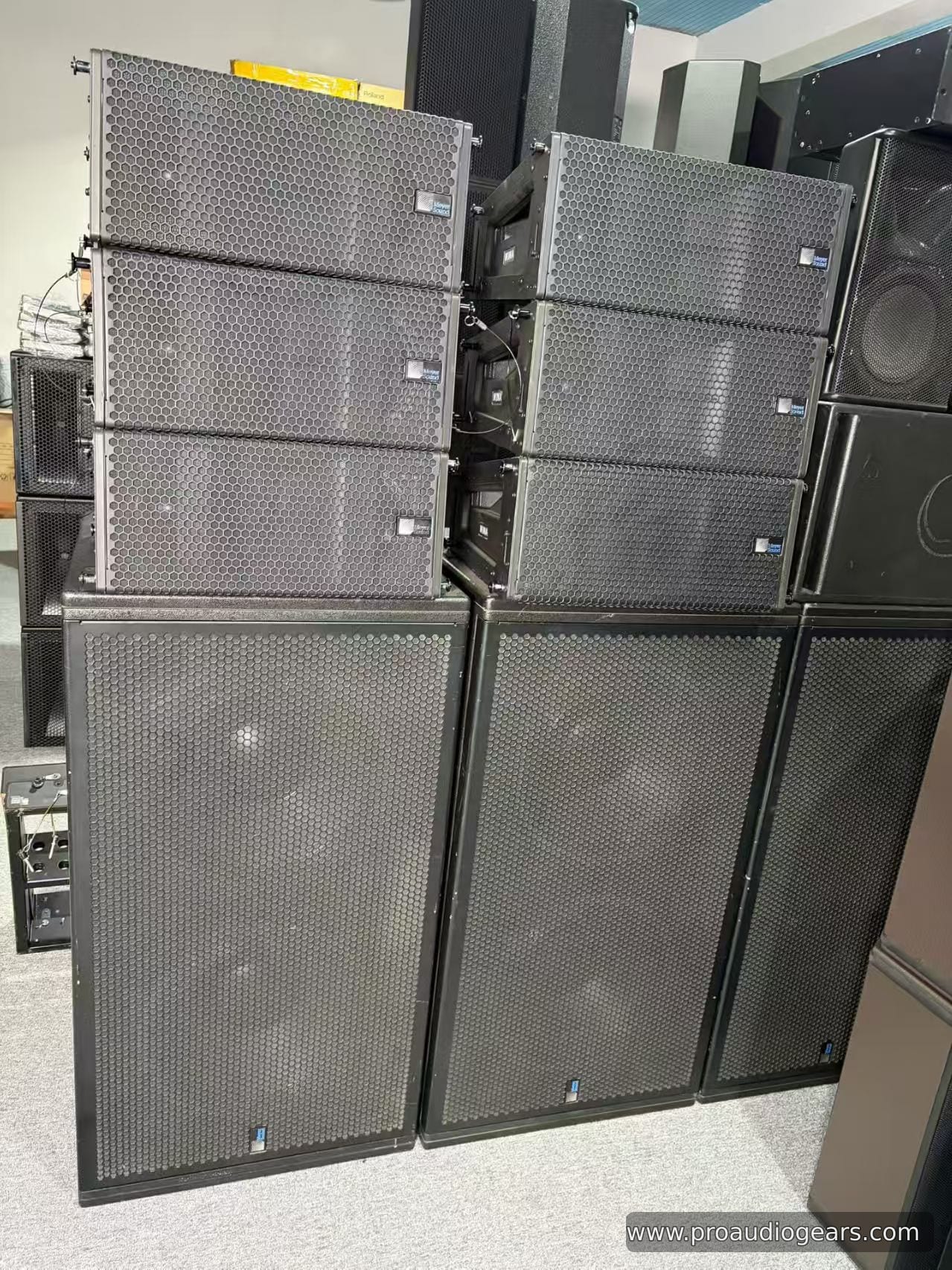
For larger installs, dual 18 inch boxes like the JBL VTX B28 dual 18 inch subwoofer are designed for array use and cardioid configurations, which is valuable in venues where you cannot put bass on the stage. Cardioid sub setups need at least two, ideally three, boxes per side and a processor with independent delay and polarity per element.
Decide powered or passive early
Powered subs simplify deployment and reduce amplifier racks, but they lock you into the manufacturer's processing. Passive subs give you flexibility if you already own amp channels and a processor. If you are buying used, check that the amp you plan to use can deliver the sub's rated power at the impedance you will wire, and that the processor has enough outputs. A four-channel amp such as the Powersoft X4 can drive two passive subs with headroom, but confirm the load before committing.
Coverage and throw
Line arrays throw; subs do not. In a long, narrow room the array may cover the depth while the low end falls away towards the back. In that case, a delay sub position or a second sub row is more useful than a bigger single stack. Sketch the room, mark the listening area, and decide where low-frequency energy actually needs to go before choosing box count.
What to check when buying used
Used subs are often the hardest-working boxes in a rental inventory. Check cones for re-coning evidence, look for cabinet swelling around handles and ports, and test every driver individually rather than trusting a quick sweep. On powered subs, confirm the amplifier module, presets and fan behaviour, and ask for the firmware state. On passive boxes, check terminal plates and internal wiring if you can.
Also confirm the array and subs you buy can actually be aligned with the gear you own. A used line array with no matching processing is a project, not a plug-and-play system.
A sensible starting point
If you are equipping a small-to-mid rental or install system, a compact array of four to six boxes per side with two to four subs per side is a proven ratio. Buy the subs first if you must choose, because a strong low end with a modest array sounds better than the reverse. Then invest in processing and time to align it properly. The difference between a matched system and a mismatched one is audible in the first minute of a soundcheck.