Subwoofer Cabinet Condition Grading: A Buyer's Field Guide
How to grade used subwoofer cabinets honestly: check the box, the driver, the horn throat and the terminals before you commit to a wholesale order from China.
Condition grades on used subwoofers are a starting point, not a verdict. A cabinet marked B can be a solid workhorse for a rental fleet or a box that needs a new driver within a month, and the grade alone will not tell you which. This guide covers what actually matters when you inspect a subwoofer cabinet, and how to translate what you find into a realistic offer.
For the general meaning of A, B and C grades across used audio gear, see our separate article on condition grades. This piece is specific to subwoofers, where the cabinet, the driver and the loading method all age differently.
Start with the box, not the driver
A subwoofer cabinet takes more abuse than any other box in the system. It sits on floors, gets dragged across stages, absorbs kicks and gets stacked in trucks. Before you listen to anything, walk around the cabinet and look at it in flat light.
- Check every corner and edge for impact damage. Split plywood at a corner is common and usually repairable, but a crushed corner on a folded horn changes the geometry of the throat.
- Press along the side panels and baffle for soft spots. Water damage shows as swelling, delamination or a dull sound when you tap the panel.
- Look at the feet and the base. Worn or missing feet mean the box has been dragged, which usually means the bottom panel and the joints have taken load.
- Check the stacking recesses and any interlocking features. If they are chipped or filled with filler, the boxes will not sit square when arrayed.
- Inspect the grille and the grille frame. A bent frame is cosmetic; a missing grille means the cone has been exposed to whatever the road throws at it.
Surface scuffs, paint wear and faded tolex are cosmetic. They should lower the price slightly, not the grade significantly. Structural damage is different, and it is where you need to be firm.
Driver inspection: the part that decides the grade
Most of the money in a used subwoofer is in the driver, so this is where you should spend your time. Ask for the grille to be removed, or remove it yourself if you are inspecting in person.
- Look at the surround. Foam surrounds degrade with age and humidity; a surround that is cracking or separating from the cone means a recone or a replacement driver.
- Push the cone gently and evenly. It should move smoothly with no scraping or grinding. Any rub means the voice coil or the gap has a problem.
- Check the spider for sag or separation. A sagging spider is common on older boxes that have been stored face-up or face-down for years.
- Look for cone damage: tears, water stains, repaired punctures. A neat professional repair can be acceptable; a blob of glue over a tear is not.
- Inspect the frame and magnet for corrosion. Rust on the frame is usually harmless; corrosion creeping into the gap is not.
- Confirm the driver is the original or a documented equivalent. Mismatched drivers in a pair will not behave the same, and that matters for cardioid setups and for even coverage.
If you cannot test the driver, treat it as needing replacement when you price the deal. That is the honest approach.
Horn-loaded and folded-horn cabinets need extra care
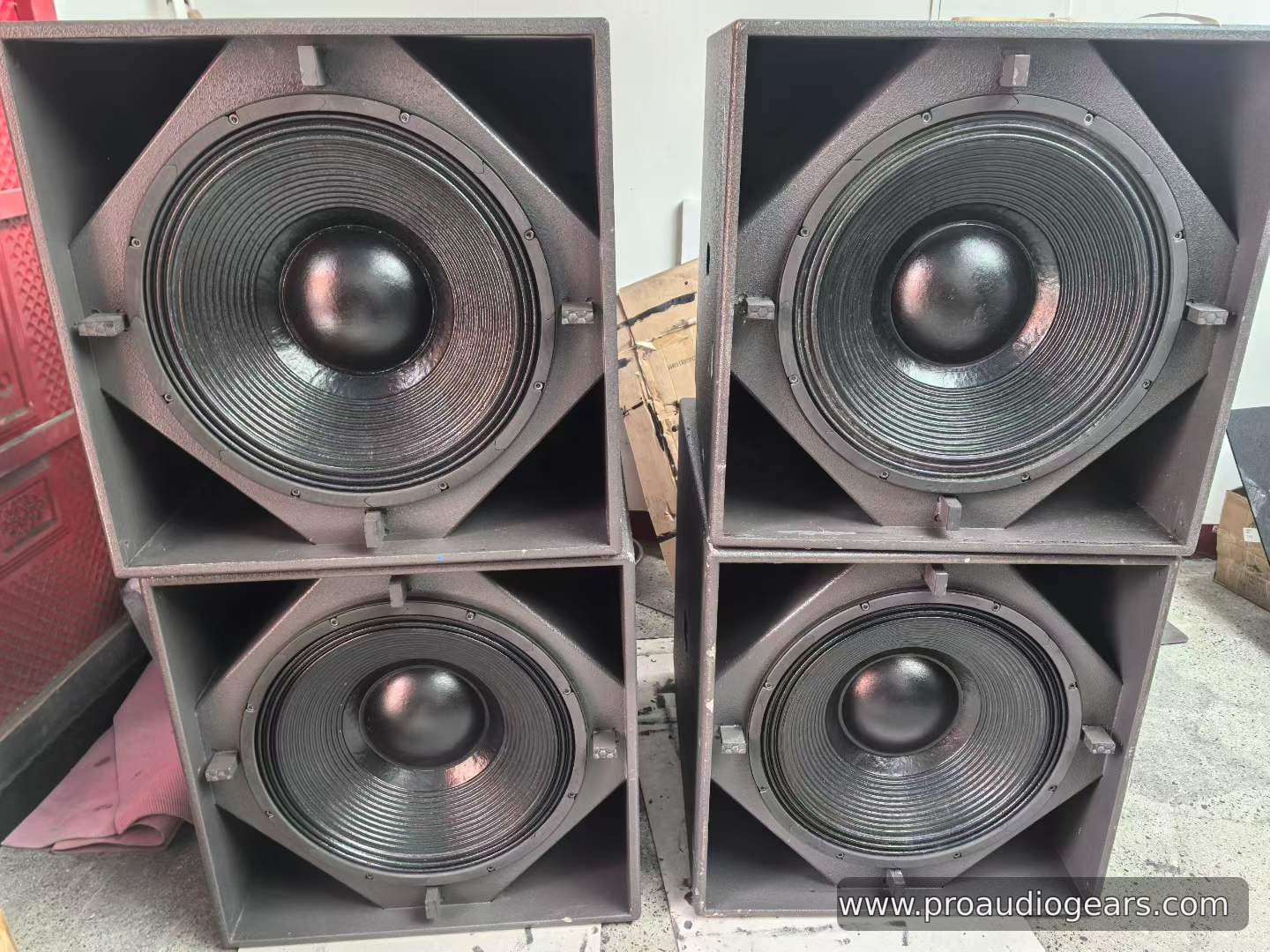
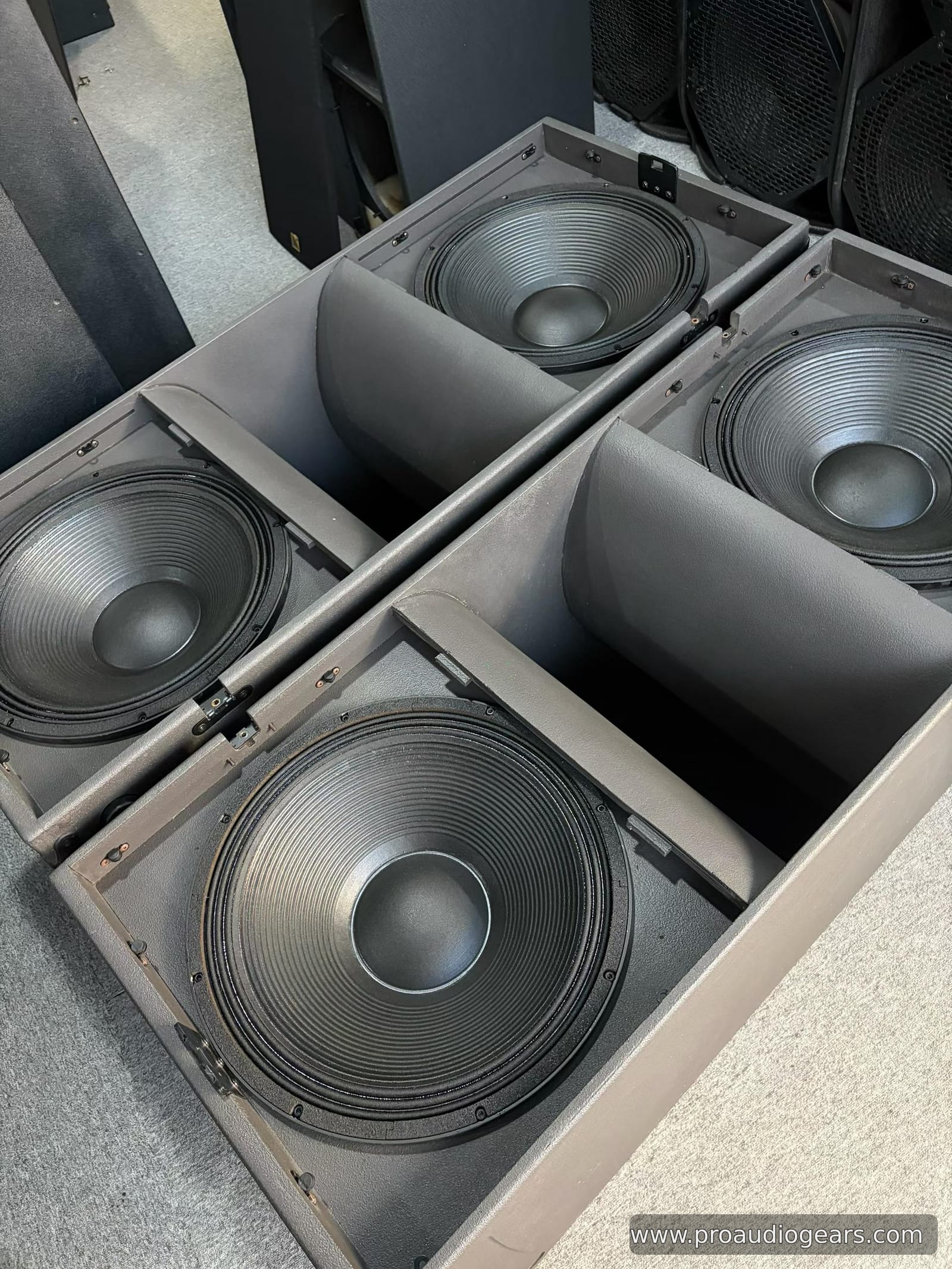
Horn-loaded designs are efficient and popular for clubs and rental work, but the loading path is also where damage hides. A used horn-loaded subwoofer pair can be excellent value, but only if the throat and the internal panels are sound.
Look into the horn mouth with a torch. You are checking for debris, loose panels, separated joints and anything that has been dropped inside. Tap along the horn walls and listen for a dead, rattling sound that suggests a detached brace. Check the throat for distortion, and check that the driver mounts flush and seals against its baffle. An air leak at the driver flange will cost you output and make the box sound thin.
For a folded horn design such as a used dual 18-inch folded horn subwoofer cabinet, also check the access panel gaskets and the internal bracing you can reach. Loose bracing buzzes at high output, and it is a nuisance to fix once the box is installed in a venue.
Terminals, wiring and hardware
Small parts fail quietly. Check the following on every cabinet:
- Speakon and terminal cup condition. Cracked cups, loose connectors and corroded pins are cheap to fix but should be noted.
- Internal wiring, if you can see it through a port or access panel. Look for spliced cable, tape joints and anything that suggests a field repair.
- Handles and pole mounts. A loose handle is a safety issue once the box is flown or carried regularly.
- Any rigging points or flyware. If the cabinet is designed to be suspended, inspect the inserts and hardware carefully, and do not accept unknowns on a flown sub.
How to map findings onto a grade
A working definition that holds up in practice:
- A: cabinet structurally sound, original driver in good order, cosmetics clean, all hardware present and functional.
- B: cabinet structurally sound, driver working and original or documented equivalent, cosmetic wear and minor hardware issues. This is the normal grade for a used rental box, and it is where most good deals sit.
- C: structural damage, non-original or damaged driver, missing hardware, or unknown working condition. Buy only at parts value or if you have a workshop.
Be sceptical of a B grade on a subwoofer with no test result. Ask the seller what was tested, how, and at what level. A short test at low volume proves the driver moves; it does not prove the box holds together at output.
Buying from a distance
When you are sourcing from China, you will usually be grading from photos and a description rather than a hands-on inspection. Ask for specific photos: each corner, the driver with the grille off, the terminal cup and the horn mouth. Ask for a short video at moderate level. Where the description is thin, price the risk in.
If the order is a mixed container, it often makes sense to include a few subwoofer cabinets alongside the rest of the system. A used dual-driver subwoofer cabinet from a known brand is a reasonable anchor for a rental fleet, provided the drivers are matched and the boxes are structurally sound. Pair it with tops from the same family where possible, so you are not fighting voicing differences later.
Finally, remember that condition grading is a commercial language, not a technical one. Two sellers can both call a box B and mean very different things. Your own inspection checklist is what protects the margin.
If you are comparing options before requesting a quote, look at our used Unknown Unknown as a starting point.
If you are comparing options before requesting a quote, look at our used Generic Dual 18-inch Folded Horn Subwoofer as a starting point.