Best Used Subwoofers for DJ Venues: A Dealer's Buying Guide
How to choose used subwoofers for DJ venues: horn-loaded vs direct-radiating cabinets, quantity per room, amplifier matching, and what to check before you buy.
DJ venues put subwoofers through a different workload than live music rooms. The low end runs continuously for hours, often from a single kick and bassline loop, and the system is expected to hold up night after night with minimal babysitting. That makes cabinet type, driver condition and power matching more important than the badge on the grille. This guide covers what actually matters when you buy used subs for a club, bar or mobile DJ rig.
Start with the room, not the cabinet
Before shortlisting anything, work out what the room can physically accept. A 200-capacity basement with a low ceiling and a single load-in stair will not take a pair of large folded horns, no matter how good the price is. Measure the available footprint, check door widths and confirm whether the subs will sit on the floor, under a stage lip or stacked as a block.
Also decide how much low end the room needs. Dance floors generally want strong output in the 40-80 Hz region, with usable extension down toward 35-40 Hz for electronic music. A bar playing background music between DJ sets needs far less. Oversizing a small room creates boom and forces you to run the subs well below capacity, which wastes money and floor space.
Horn-loaded versus direct-radiating cabinets
Most used subs you will find fall into two families.
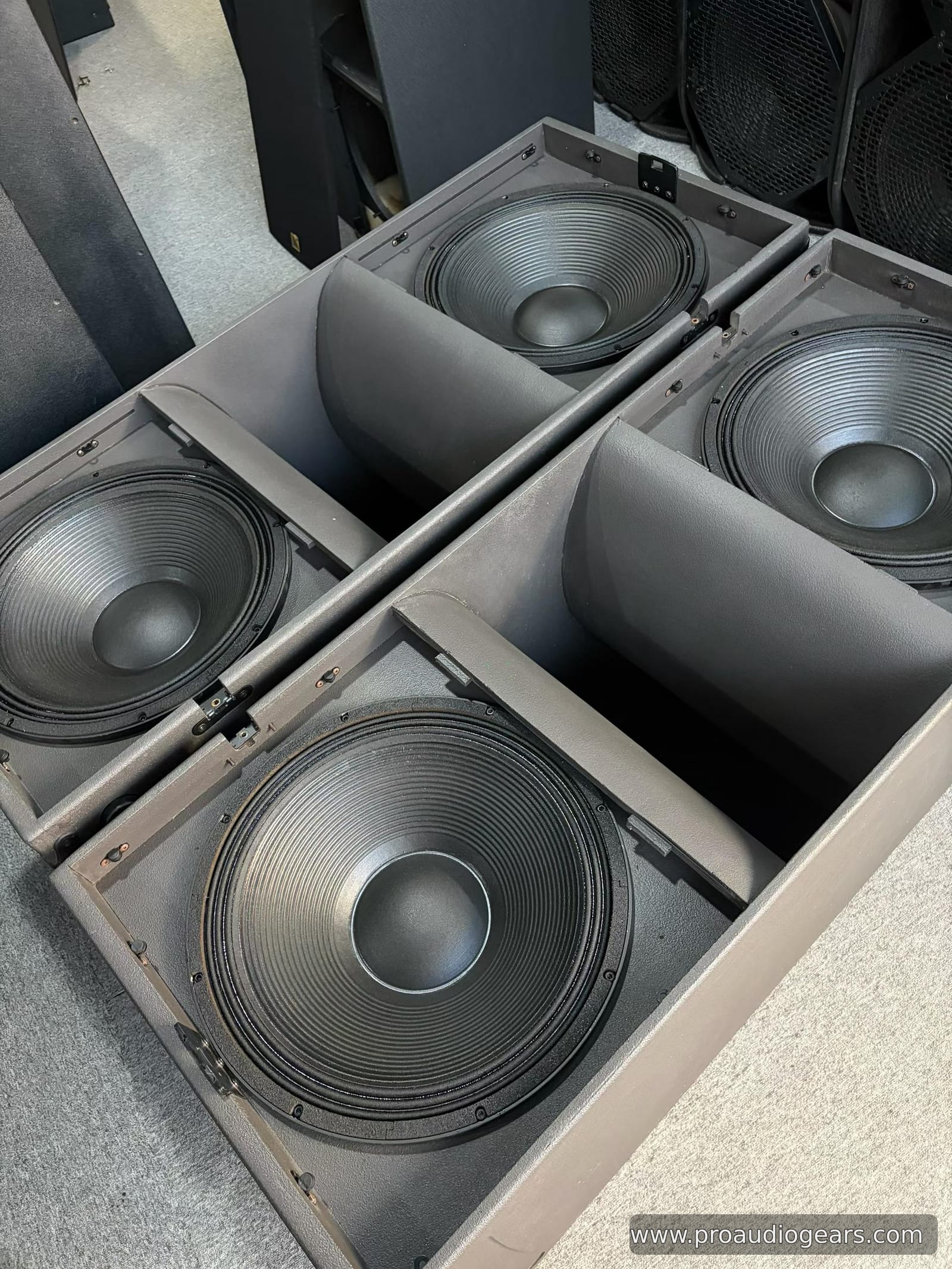
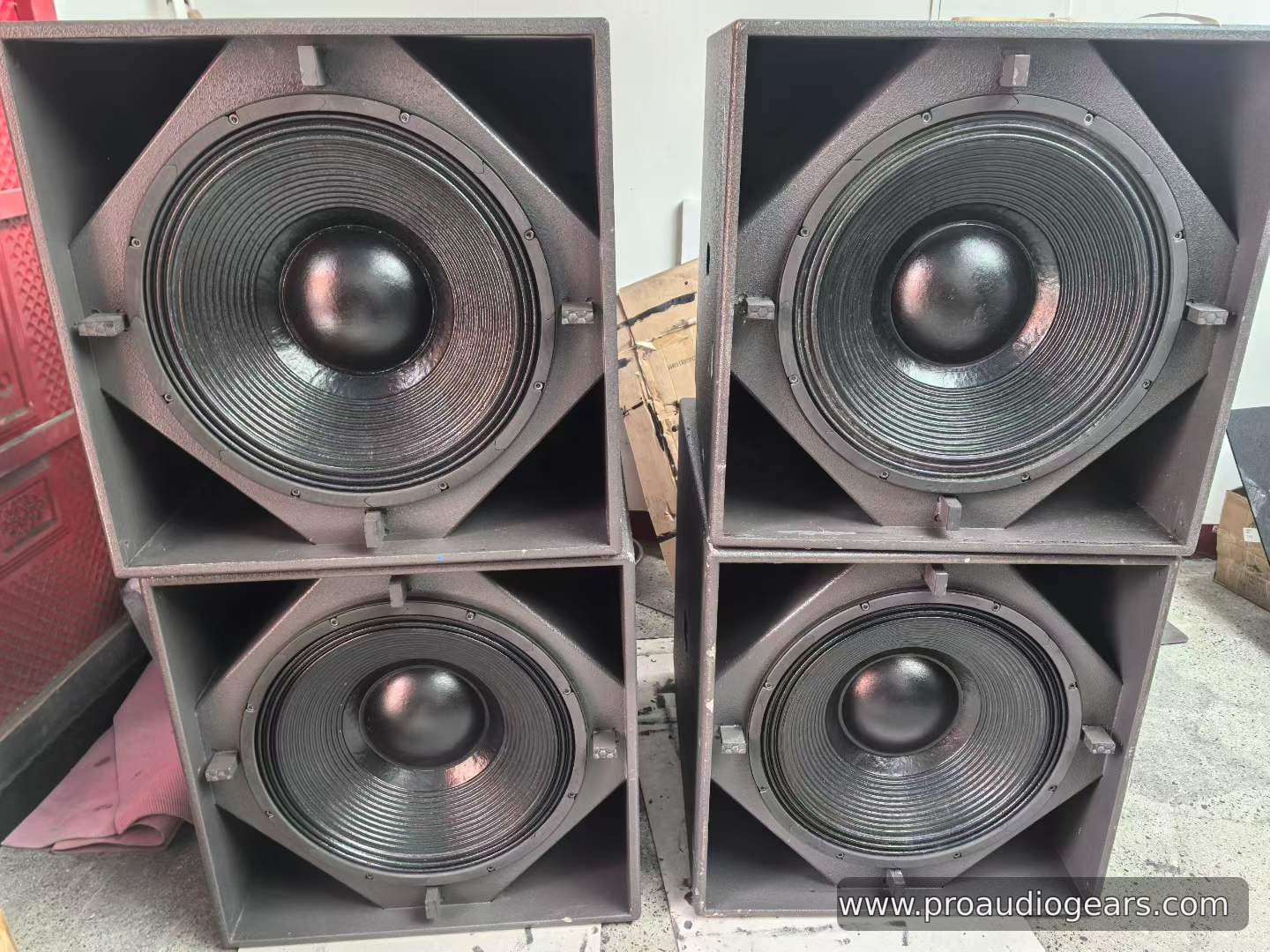
- Horn-loaded and folded horn cabinets convert amplifier power into output very efficiently and produce a punchy, fast sound that suits dance music. They are physically large, heavy, and their response usually rolls off below 40 Hz unless they are designed as true sub cabinets rather than bass bins.
- Direct-radiating bass reflex cabinets are simpler, lighter and more predictable. They need more amplifier power for the same output but are easier to array and easier to repair.
For a fixed club install with a dedicated sub position, a folded horn design is often the better use of amplifier budget. A used dual 18-inch folded horn subwoofer cabinet is a common choice for venues that want maximum output per amplifier channel, provided you have the floor space and a way to move it. For rental fleets and venues that reconfigure the room, lighter reflex boxes usually win on logistics.
How many cabinets do you actually need
The honest answer is that cabinet count is driven by room volume and target level, not by a fixed rule. As a working starting point for DJ venues:
- Small bar or lounge, up to roughly 100 people: one or two 18-inch subs, or a single horn cabinet, placed together in one corner or along one wall.
- Mid-size club, 150 to 300 people: two to four 18-inch subs, ideally grouped rather than split to opposite sides of the room.
- Larger rooms and warehouse-style spaces: four or more cabinets in a block, with delay fills if the room is deep.
Grouping subs together rather than splitting them left and right gives more even coverage across the dance floor and avoids the power-alley problem where the centre of the room gets far more bass than the sides. If you already own tops and are adding low end, the same logic applies when you are matching cabinets to an existing system.
Amplifier power and processing
Passive subs need an amplifier that can deliver sustained power into the cabinet's actual impedance, not just a peak figure on a spec sheet. Check the cabinet's rated continuous power and impedance, then confirm your amp is stable at that load and can deliver roughly the rated power per channel. Running a sub hard from an undersized amp is one of the fastest ways to destroy drivers.
Processing matters as much as power. A high-pass filter protects drivers from subsonic content, a low-pass filter keeps the sub out of the vocal range, and a limiter prevents runaway gain from a DJ who pushes the master. If your amplifier does not include DSP, budget for an external processor or a crossover with limiting.
What to inspect on a used subwoofer
Used subs are often sold after years of hard club duty, so inspection is not optional.
- Push each cone gently and evenly. Any scraping, rubbing or roughness in the voice coil means the driver is on its way out.
- Look for cone creasing, separation at the surround, and repairs around the spider. Foam surrounds rot; recone kits may not exist for obscure models.
- Check the cabinet for water damage, swollen particle board, cracked joints and loose speakon or terminal panels. Horn cabinets are especially prone to damage at the throat and mouth edges.
- Confirm the cabinet is the model it claims to be. Ask for impedance and power ratings, and check whether the drivers inside match each other.
- Test at moderate level with music containing sustained low frequency, not just a short thump, and listen for rattles, air leaks and port noise.
The same discipline applies to any passive cabinet you are buying in quantity. If you are also sourcing tops or bass bins, a used horn-loaded subwoofer pair is worth inspecting carefully for matching drivers, since mismatched cabinets in a pair cause uneven loading and unpredictable behaviour on the dance floor.
Condition grades and spare parts
Condition B is normal for used club subs and usually means cosmetic wear with functional drivers. What matters is whether the drivers are original, whether they have been reconed, and whether replacements are still available. Before committing to a quantity, confirm the driver model and check that a recone kit or equivalent driver can be sourced. A cabinet with no spare parts path is a liability in a working venue.
Practical buying notes for dealers and installers
- Buy subs in matched pairs or blocks where possible. Mixed cabinets in one room create phase and level problems that no amount of EQ fixes cleanly.
- Ask for photos of the driver rear, the terminal panel and the cabinet edges, not just the front grille.
- Confirm weight and dimensions before arranging freight; horn cabinets are bulky and freight cost can rival the purchase price on small orders.
- For export orders, request that cabinets are crated with the grilles protected and drivers braced, and confirm voltage and connector standards for the destination market.
- Budget for new speakon connectors and fresh gaskets. These are cheap and eliminate a common source of intermittent faults.
A used subwoofer is a long-term purchase for a DJ venue. Choose the cabinet type that fits the room, size the block to the space, match the amplifier honestly, and inspect the drivers properly. Do that, and a well-chosen used sub will outlast several generations of DJs.