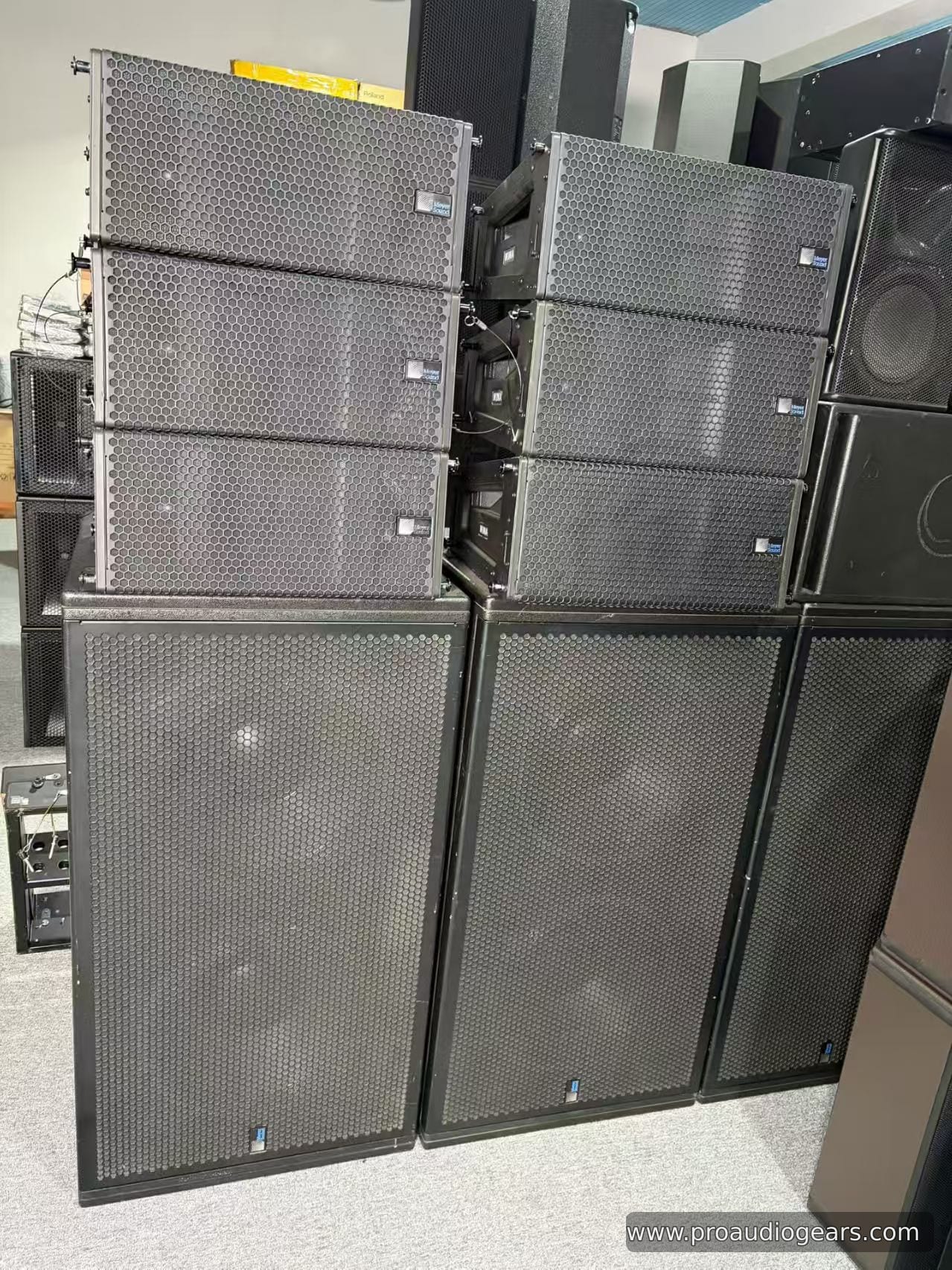
Choosing a Line Array for a 500 Capacity Venue
A practical guide to specifying a used line array for a 500 capacity room: box count, throw, subwoofer strategy, amplification and processing decisions that actually matter.
A 500 capacity room sits in an awkward middle ground. It is too big for a point-source rig to cover evenly without serious compromises, and too small to justify the full touring-scale arrays that rental companies keep in their inventory. Most buyers in this bracket are installing a house system, upgrading a club that has outgrown its old PA, or adding a mid-size array to a rental fleet. This guide covers the decisions that matter when specifying a used line array for that room size.
Start With Coverage Geometry, Not Box Count
The first question is not how many boxes you need but what shape the audience area has. A 500 capacity standing room with a flat floor and a low stage needs very different vertical coverage from a tiered or balconied venue. Measure the depth from the front row to the back wall, the height of the trim point, and the vertical angle you need to hit the last row without blasting the first three rows.
A typical 500 capacity room is roughly 15 to 25 metres deep. With a trim height of 4 to 6 metres, a hang of four to six boxes per side usually covers the space. Fewer boxes means wider splay angles and more level variation front to back; more boxes means tighter splay and more even coverage but a heavier, more expensive hang. Do not buy twelve boxes for a room that needs six. You will pay for rigging, amps and truck space you never use.
Box Choice at This Scale
At this size, compact and mid-format line array modules are the right tool. A used RCF HDL 6-A module is a sensible candidate for a 500 capacity install: it is a powered compact box, which removes amplifier rack planning from the equation, and six to eight per side is a realistic hang for a room of this depth. If you are building a passive system instead, the used d&b audiotechnik V8 line array cabinet is a well-known mid-format box that suits venues in this bracket, though you will need to budget for amplification and processing separately and inspect Condition B cabinets carefully for horn and driver damage.
Whichever you choose, keep the whole hang from one model and one production batch where possible. Mixing modules within a single array compromises the coupling the design depends on, and mixed used stock makes future servicing harder.
Subwoofers: Decide the Format Before the Brand
For a 500 capacity venue, subwoofer requirements depend heavily on the music policy. A live rock or function room needs low-end reinforcement that keeps up with a kick drum without overwhelming the room. A club playing electronic music needs considerably more headroom and a cardioid or at least carefully arrayed layout to keep bass off the stage.
As a rough planning figure, two to four dual-18 subwoofers is common for this room size, placed in a block or split left and right. Avoid spreading subs wide apart unless the room forces it; clustering keeps coupling tight and reduces the power alley problem. The JBL VTX B28 is a dual-18 design suited to this scale, and the RCF SUB 8006-AS is a powered option that pairs naturally with an RCF array. Neither is a substitute for measuring the room, but both are in the right class.
Amplification and Processing
If you buy powered boxes, your amplifier decisions are mostly made for you, and the remaining work is processing and distribution. If you buy passive boxes, plan the amp racks around the array's power handling and impedance, not around whatever amplifier happens to be cheap this month.
A four-channel amplifier such as the Powersoft X4 covers a modest passive hang efficiently, while a Lab.gruppen PLM 20K44 with Lake DSP gives you onboard processing per channel and is a common choice for d&b and similar passive systems. Condition C units can be good value but should be treated as projects; test them thoroughly before committing to a full rack.
Processing deserves its own line in the budget. A dedicated loudspeaker processor such as the Lake LM 44 or a dbx DriveRack PA2 lets you load manufacturer presets, set array EQ and delay zones, and protect the system from operator error. Do not run a used line array without proper processing and limiters.
Rigging, Trim and Safety
A 500 capacity venue usually has a fixed rigging point, a mother grid or a balcony structure. Confirm the structural rating before you buy anything, and confirm the array's own flyware is complete and undamaged. Used arrays are frequently sold without bumper frames, shackles or link bars, and replacement flyware is expensive and slow to source.
Plan the trim height so the bottom box is above head height at the front row and angled down toward the rear. If your ceiling is low, a line array may be the wrong choice and a well-designed point-source system with delays will serve the room better.
System Control and Consoles
At 500 capacity, most operators want a digital console with enough buses for monitors, delays and a recording feed. The Allen & Heath SQ-6 is a common house console at this level, and the Yamaha DM3 suits smaller rooms or a secondary mix position. Buy the console after the PA is specified, not before, so the output count matches the system.
What to Check Before You Commit
- Verify the room's structural rigging rating and trim height before selecting a hang length.
- Confirm the array comes with complete flyware, or budget for replacements.
- Ask for impedance and power handling data for passive boxes so amplifier planning is accurate.
- Inspect every used cabinet for horn damage, water ingress and cabinet delamination.
- Budget for processing and limiters even on a powered system.
- Leave headroom in the amplifier and subwoofer budget; a 500 capacity room run at the edge of its system will fail at the worst moment.
A 500 capacity venue rewards restraint. A well-chosen four to six box hang per side, two to four subwoofers, correct processing and safe rigging will outperform a larger, poorly specified system every time.
If you are comparing options before requesting a quote, look at our used RCF HDL 6-A as a starting point.