Compact Line Arrays for Club Installation: A Buyer's Guide
How to spec a compact line array for club installation work: coverage, sub matching, amplification, processing and what to check on used modules before you commit.
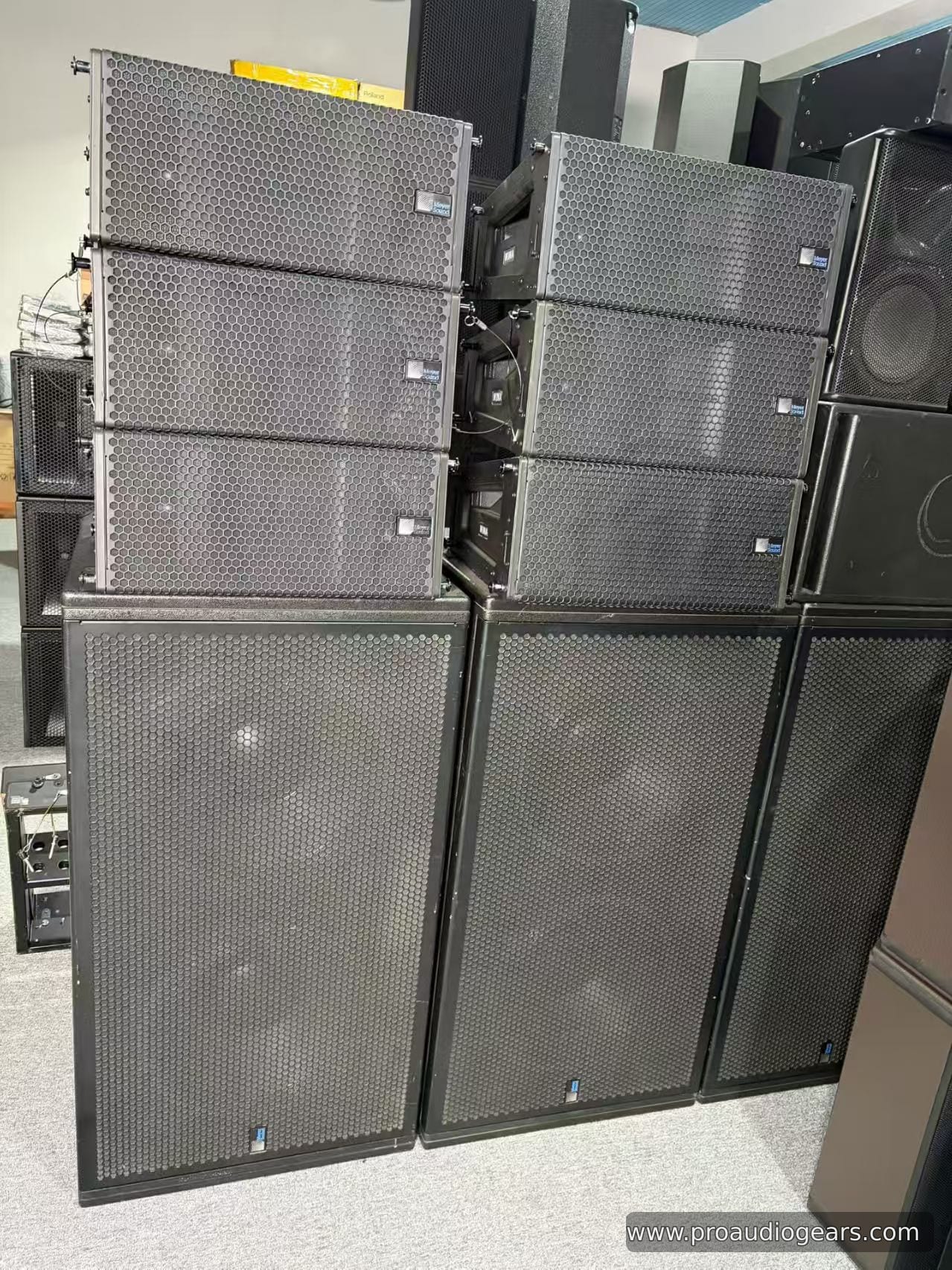
A club is one of the harder rooms to put a line array into. Ceilings are low, the dancefloor is close to the stage, and the bar or VIP area usually sits off to one side where you need coverage without blasting the people standing at the rail. A full-size touring hang is the wrong tool. A compact line array, deployed in short arrays of four to eight boxes per side, is usually the right one — provided you match it to the room rather than to a spec sheet.
Start with the room, not the box
Before you shortlist anything, measure. Ceiling height at the flown position, the horizontal angle from the array to the furthest and nearest seats, and the vertical drop from the top box to the audience plane all determine how many boxes you need and at what splay angles. A club with a 4.5 m ceiling and a 12 m deep floor typically wants four to six compact modules per side with progressive splay, not a long throw array trimmed down.
Two practical constraints dominate club installs. First, sightlines: the array has to fly where it does not block the stage or the video wall. Second, weight and rigging: many club ceilings are not rated for a touring-grade hang, so compact and lightweight modules are often the only realistic option without structural work.
Compact line array options worth considering
In the used market, two families come up often enough to plan around. The RCF HDL 6-A is a powered compact module that suits small and mid-size rooms well because amplification and processing are onboard, which simplifies the rigging and cabling plan considerably. If you are pricing a four-to-six box hang per side, a used RCF HDL 6-A line array module is a sensible starting point, and condition A stock reduces the risk on a first installation.
The d&b audiotechnik V8 is a larger, passive cabinet that needs proper amplification and DSP, but it is a common choice where the room is bigger or the brief calls for more headroom. A used d&b V8 line array cabinet in condition B is realistic for installers who already own compatible amp racks and Lake processing, and it holds resale value better than most.
There is no universal winner here. Powered compact boxes win on installation simplicity and cable count; passive boxes win when you already have a rack and want to standardise on one amplifier platform across multiple rooms.
Subwoofers: cardioid or not
A club install almost always needs subwoofers, and the placement decision matters more than the model. If the stage is against a wall and the dancefloor is directly in front, a cardioid sub arrangement keeps low end off the stage and reduces rumble in the DJ booth. That usually means pairs or groups of four, not a single box per side.
Match sub output to the array, not to the room volume alone. A compact array of six modules per side will run out of headroom before a pair of large dual-18 subwoofers does, so undersizing the sub section is rarely the mistake — oversizing it and then failing to align it is. Time alignment and a proper crossover between subs and array are what make the system sound like one rig.
Amplification and processing
If you go passive, the amplifier and processor choice defines the result. Two used options appear regularly in export stock: the Powersoft X4, a four-channel amplifier with onboard DSP that suits compact installs neatly, and the Lab.gruppen PLM 20K44 with Lake DSP, which is a more capable platform but often turns up in lower condition grades. Condition C on a PLM is not automatically a problem, but budget for a service check and confirm the Lake licence situation before you buy.
For system processing, a dedicated loudspeaker processor is worth the rack space. The Lake LM 44 and dbx DriveRack PA2 both appear in used stock; the LM 44 is the more flexible tool for multi-zone club systems, while the PA2 is simpler and adequate for a single-room install.
Control and sources
Club installs increasingly need a compact digital console at FOH or in a booth. The Allen & Heath SQ-6 and Yamaha DM3 are both common, and either will handle DJ inputs, a couple of vocal mics and a background music source without drama. Keep the DJ equipment on its own inputs and avoid routing it through the same gain structure as microphones.
What to verify before you commit to used modules
Used line array modules are generally safe purchases if you check the right things. Grille and cabinet condition tells you how the boxes were handled; horn and waveguide condition tells you whether they were driven hard. Ask for impedance readings on passive boxes and confirm that powered modules power up and pass signal on every input. Check that rigging hardware, pins and fly bars are present and undamaged — replacement rigging is often the most expensive part of a used purchase.
Condition grades help but do not replace a test. A condition B cabinet with intact drivers and rigging is a better buy than a condition A box with missing flyware.
Budgeting the whole install
Price the array, subs, amplification, processing, cabling, rigging and labour as one number. Compact line arrays often look cheap per box and then surprise buyers on rigging and cable. If the ceiling needs a steel frame or a certified engineer's sign-off, that cost belongs in the comparison before you choose between a powered compact system and a passive one.
Finally, plan for expansion. A club that installs four boxes per side today may want six in two years. Choose a family where modules are available on the used market and where the amplifier platform can absorb another pair of boxes without replacement.